Pub.lished Movie Reviews
The Hudsucker Proxy (1994)
"The Hudsucker Proxy" (1994) is a fantastic screwball comedy from the Coen Brothers. It cleverly explores corporate affairs at the executive level, all the while paying an affectionate homage to the screwball comedies of the 1930s and '40s. There's no doubt that the Coens meticulously studied the rapid-fire scripts and masterful cinematography prominent during this golden era of Hollywood.
It's immensely satisfying to witness a villain, who has devised an overly complex plan, see it crumble into pieces. This is not because the protagonist develops a more cunning and labyrinthine counter-plan, but simply because - contrary to what most movies might suggest - overly complex plans are inherently flawed and, quite frankly, entirely stupid.
This movie brilliantly highlights that complexity should never be confused with intelligence or shrewdness. While it may be tempting to associate simple ideas with simple people, the film argues that crafting a truly simple concept often requires an astoundingly sharp mind.
This is the essence of "The Hudsucker Proxy." It's a film that not only showcases the usual Coen Brothers magic - think witty, rapid-paced dialogue, stunning cinematography, and fast-paced action - but also flexes some serious screwball chops. It's an engaging, clever, and entertaining watch that will leave you appreciating the beauty of simplicity.
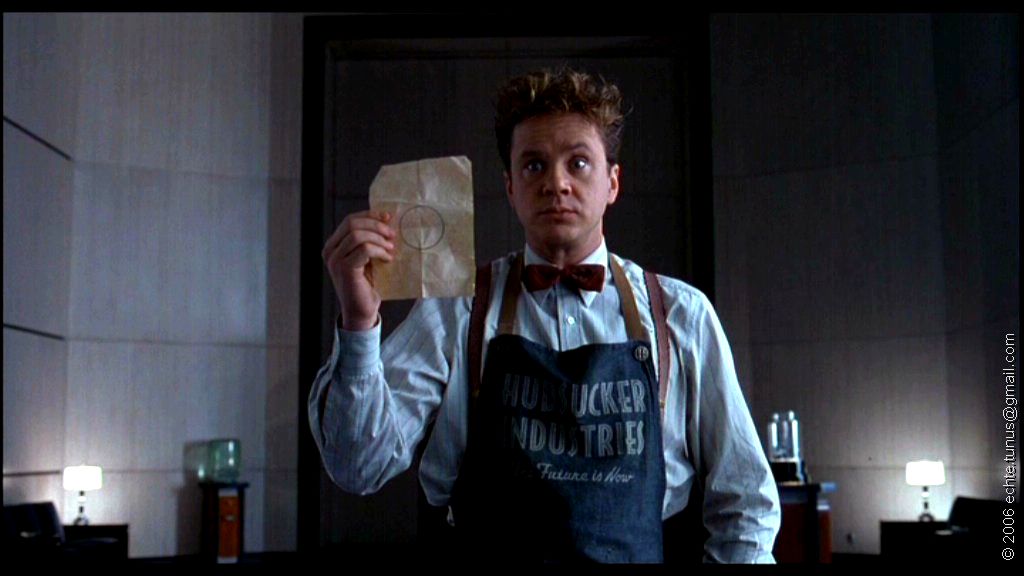
"What do you do if the envelope is too big for the slot?"
"Well, if you fold 'em, they fire you. I usually throw 'em out."
- You don't appreciate dark humor or satirical themes.
- You do not enjoy movies with an intricate and quickly paced plot.
- You are not a fan of Coen Brothers' style of filmmaking.
- You're seeking a conventional, mainstream Hollywood story.
Warning: The following may contain spoilers:
What's the deal with "The Hudsucker Proxy?"I mean, a guy gets promoted to CEO of a big corporation because he has a drawing of a circle? That's his big idea? I can't even get a seat at a crowded diner if I draw a circle. "Oh, you've got a doodle of a circle, sir? Right this way to the best table in the house!"
And who knew that running a business was so much like a game of hot potato? One minute you're the janitor, next minute you're running the show, then you're out on the ledge about to jump. It's like musical chairs with stock options.
But, I gotta say, my favorite part is when Tim Robbins looks at a simple circle and goes, 'You know, for kids!' I mean, who knew geometry could be so entertaining? So remember folks, next time you're in a business meeting, just draw a circle. Apparently, it's the key to success!
Fight Club (1999)
Fans of "The Hudsucker Proxy" (1994) are likely to enjoy "Fight Club" (1999) due to both films' satirical take on corporate culture and consumerism. "The Hudsucker Proxy," with its absurdly comical depiction of corporate ladder climbing, shares thematic parallels with Fight Club's darker, more violent critique of materialistic obsession and corporate monotony. Both films, while vastly different in tone, offer a unique and stylized cinematic experience, filled with memorable performances, distinctive dialogue, and thought-provoking commentary on society's relationship with consumer culture.
American Beauty (1999)Devotees of "The Hudsucker Proxy" (1994) will also enjoy "American Beauty" (1999) because both films share common themes of satire, corporate satire, and the exploration of the American Dream. Each film uses creative storytelling and unique visual styles to represent characters who experience disillusionment with their seemingly perfect lives, leading to drastic personal transformations. Moreover, both films offer social criticism wrapped in dark humor, compelling drama, and memorable performances, especially from lead actors Tim Robbins and Kevin Spacey, respectively.
Memento (2000)"The Hudsucker Proxy" and "Memento" are cinematic masterpieces that play with narrative structure and storytelling conventions, resulting in a unique viewing experience. "The Hudsucker Proxy," with its quirky characters and comedic yet poignant story, shares thematic elements with "Memento," which is a psychological thriller that unravels in reverse. Both films require the audience to pay close attention to the plot, and they each offer a rewarding, complex narrative that invites repeated viewings. Furthermore, they both have strong visual styles that contribute to their storytelling, and they are helmed by two visionary directors, Joel Coen and Christopher Nolan, who have a knack for creating distinctive, memorable films.
The Big Lebowski (1998)"The Hudsucker Proxy" (1994) and "The Big Lebowski" (1998) are films by the Coen Brothers, known for their unique brand of quirky humor, distinctive storylines, and memorable characters. Each film showcases the Coens' knack for blending comedy with drama, their talent for sharp dialogue, and their capacity to create visually stunning, thematically rich, and deeply ironic cinematic universes. As such, fans of the whimsical satire of corporate culture in "The Hudsucker Proxy" are likely to appreciate the laid-back, noir-tinged tale of mistaken identity in "The Big Lebowski," as both films offer similarly engaging narratives and share the Coen Brothers' signature style and wit.
Monty Python and the Holy Grail (1975)Connoisseurs of "The Hudsucker Proxy" (1994) will likely enjoy "Monty Python and the Holy Grail" (1975) because both films share a unique blend of satire, slapstick comedy, and surrealism. Just as "The Hudsucker Proxy" uses its 1950's corporate setting to satirically comment on the American Dream and capitalism, "Monty Python and the Holy Grail" uses the Arthurian legend to parody chivalry and British history. Both movies rely heavily on visual gags and rapid-fire dialogue, and they both utilize their respective settings to construct a quirky, offbeat world that is simultaneously familiar and absurd. If you appreciate the wit, style, and humor of "The Hudsucker Proxy," you'll likely find the same qualities in Monty Python and the Holy Grail.
This Is Spinal Tap (1984)Fanciers of "The Hudsucker Proxy" will love "This Is Spinal Tap" as both films share a clever, satirical style that skewers American business and entertainment industries, respectively. Both feature eccentric characters, intricate plots, and a unique blend of comedy and drama that maintains a balance between absurdity and realism. The dry humor, sharp dialogue, and visual gags that make "The Hudsucker Proxy" a standout are also prominent in "This Is Spinal Tap," making it a must-watch for those who appreciate the Coen Brothers' distinctive storytelling approach.
Raising Arizona (1987)"The Hudsucker Proxy" and "Raising Arizona" are directed by the Coen Brothers, known for their unique blend of comedy, drama, and quirky narratives. These films share a similar visual style, eccentric characters, and a distinctive sense of humor. The offbeat dialogue, stylized performances, and intricate plots found in both films make them a delight for viewers who appreciate unconventional storytelling and a touch of the absurd. Additionally, both films are set in stylized versions of the mid-20th century, appealing to viewers who enjoy period piece aesthetics.
Edward Scissorhands (1990)Admirers of "The Hudsucker Proxy" will love "Edward Scissorhands" because both films share a unique blend of whimsy, dark humor, and poignant social commentary, delivered with stunning visual aesthetics. They are both distinctive examples of their directors' styles, with the Coen Brothers' signature eccentric narrative in "The Hudsucker Proxy" and Tim Burton's imaginative and gothic storytelling in "Edward Scissorhands." Both films feature an innocent and naïve protagonist navigating a cynical world, and use their fantastical plots to satirize corporate greed and societal conformity.
Rushmore (1998)"The Hudsucker Proxy" and "Rushmore" are quirky, stylized films that blend humor with a unique visual storytelling approach. They share a similar eccentric tone and thematic elements about dreamers trying to achieve their ambitious goals, while dealing with love and personal growth. These films also boast of memorable performances, sharp dialogue, and a keen eye for detail, which are hallmarks of their respective directors, the Coen Brothers and Wes Anderson. Therefore, those who appreciate the whimsical comedy-drama and distinctive cinematic style of "The Hudsucker Proxy" will likely enjoy "Rushmore" as well.
Best in Show (2000)Connoisseurs of "The Hudsucker Proxy" (1994) will likely enjoy "Best in Show" (2000) as both films share a stylized approach to comedy, focusing on vibrant characters and hilarious, satirical takes on their respective themes. The Hudsucker Proxy's parody of corporate greed and Best in Show's send-up of dog shows are both executed with a similar blend of eccentricity, wit, and visual flair, making the latter a great fit for those who appreciate the unique humor and distinctive storytelling style of the former.
Barton Fink (1991):If you enjoyed The Hudsucker Proxy, another Coen Brothers film, Barton Fink, might be a good fit for you. This film, like The Hudsucker Proxy, has a unique blend of comedy, drama and is set against the backdrop of a 1940s Hollywood studio. The Coen Brothers' distinctive style of storytelling is very much at play here, and it's a must-see for any fan.
Raising Arizona (1987):This is an earlier work of the Coen Brothers. It's a crime comedy film where the unique humor and storytelling style of the Coens shines through. Like The Hudsucker Proxy, this movie also has an assured mix of whimsical humor and sharp wit, making it a highly enjoyable watch.
Moonrise Kingdom (2012):This is a Wes Anderson film, who is known for his eccentric and stylistic approach to filmmaking. The movie shares some of the same quirky charm as The Hudsucker Proxy. It's a witty, warm and brilliantly crafted coming-of-age story told in a very creative way.
The Grand Budapest Hotel (2014):This one is also a film by Wes Anderson. It shares similarities with The Hudsucker Proxy in terms of its unique visual style, quirky characters, and humorous dialogue. It's a delightful, stylish adventure that's filled with a sense of nostalgia, charm and wit.
Like this? Then click here to see more comedy movies