Pub.lished Movie Reviews
Seven Samurai (1954)
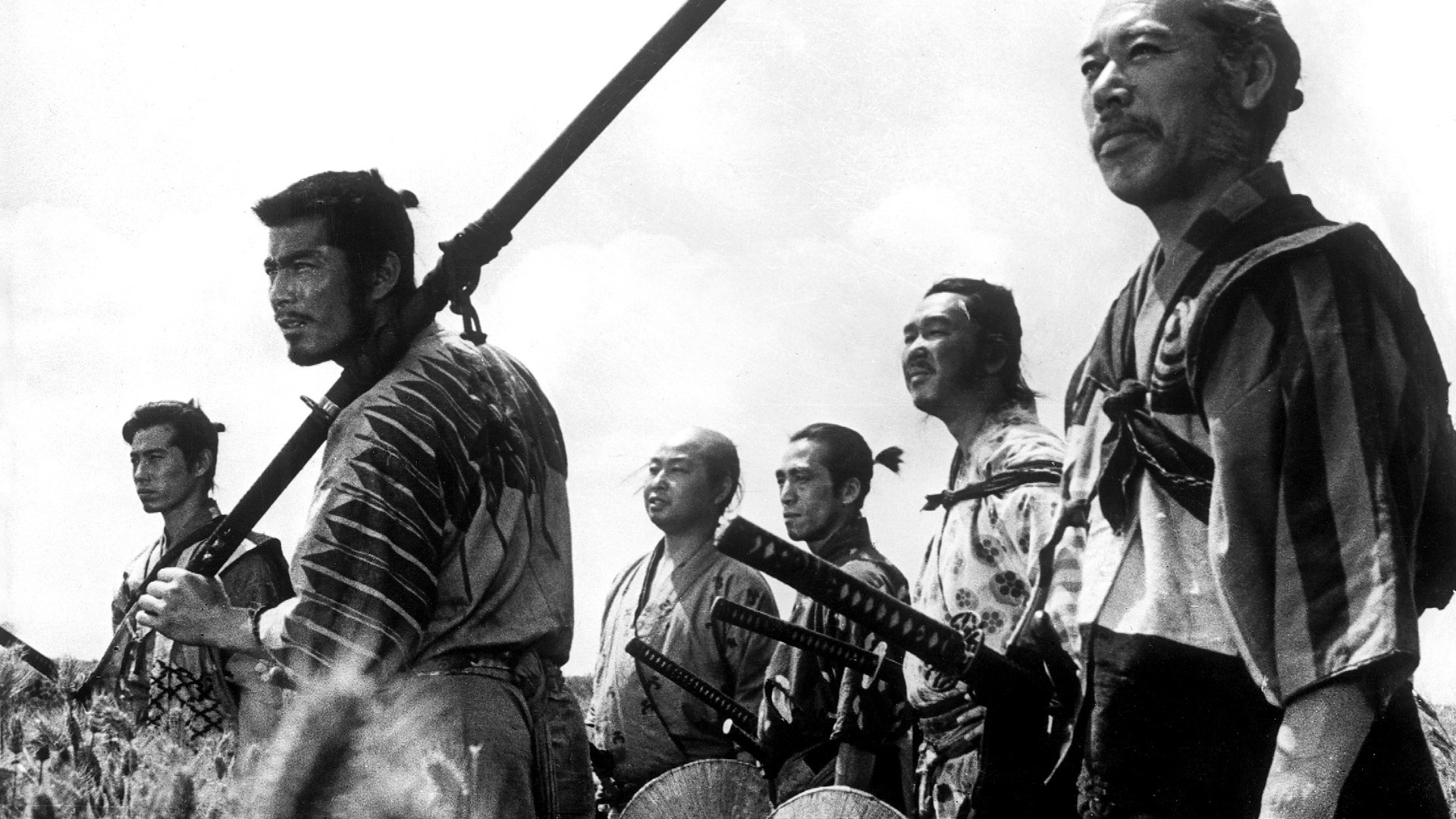
This movie isn't just the best samurai movie ever made; it is one of the best movies ever made."Seven Samurai," released in 1954, is widely acclaimed as the finest film to ever emerge from Japan and indeed, stands as one of the greatest films of all time. It whirls along at a brisk pace, brimming with action, and it is this film that popularized the now familiar trope of assembling a motley crew of diverse individuals, each with their unique strengths, to save the day.
Originally, the script was penned with six noble samurai in mind. However, the writers soon realized that this would render the movie somewhat monotonous. To infuse a dose of unpredictability and excitement, they recast the phenomenal Toshiro Mifune as a wild, uncontrollable rogue, who injected an element of uncontrolled energy and humor into the film.
Director Akira Kurosawa tightly orchestrated every element of his films, except one: Mifune's character Kikuchiyo is largely improvised. Mifune deeply researched all his roles, thoughtfully considering how to infuse realism, dignity, and humor into his characters.
Set against the backdrop of feudal Japan, "Seven Samurai" introduces us to the world of Ronin, or masterless samurai, wandering the land. Too dignified to resort to farming, yet too impoverished to survive without gainful employment, these Ronin, deprived of a new master, often found themselves in the unenviable position of becoming hired swords or bandits.
The story is a stark reflection of life in Japan at that time, dominated by struggling peasant farmers barely eking out a living. These farmers found themselves caught in a perpetual struggle against both the oppressive noble landowners and the equally parasitic bandits.
Our protagonists, the farmers, overhear plans of a bandit attack on their town post-harvest and decide to hire starving Ronin who would be willing to defend their town for a meager wage. The Ronin assemble and undertake the task of training the farmers to mount a defense of their own.
"Seven Samurai" is a masterful period piece as well as a thrilling action movie, easily holding its own against the best of today's action-packed blockbusters. If you have even a rudimentary understanding of Japanese feudal culture, you'll be able to fully appreciate the brilliance of this film. This isn't just a movie, it's a deep dive into a fascinating world, a world as rich as it is brutal, as beautiful as it is harsh. It's a world where honor is held above all else, and where a handful of men, despite their differences, come together to protect those who cannot protect themselves.
- You are under the recommended age range of 13 due to violence and intense themes.
- You prefer movies with a short runtime. Seven Samurai is over three hours long.
- You don't enjoy films with subtitles or films in black and white, as it is a Japanese film from the 1950's.
- You don't enjoy historical or period films. This is set in the era of the Samurai.
- You are not a fan of complex, multi-character plots. The film explores the stories of several characters.
- You don't appreciate slower, contemplative pacing. Despite the action, much of the film is meditative.
- You prefer light, uplifting films. The film has a serious tone and explores significant themes of sacrifice and mortality.
Warning: The following may contain spoilers:
What's the deal with "Seven Samurai?"I mean, these guys are supposed to be the best warriors around. But they're not getting paid, they're not getting any recognition, they're basically doing community service. You ever notice how samurai in movies are always doing community service? Why’s that? They're like the medieval Japanese version of people who got caught littering.
And let's talk about the seven of them. Seven, really? Isn't that a bit much? You ever try to coordinate plans with seven people? It's a nightmare! There's always one guy who's late, one guy who forgot his sword, one guy who didn't get the memo about the change in battle plans. I mean, come on, keep it simple folks!
Yojimbo (1961)
Both "Seven Samurai" and Yojimbo are seminal works by master filmmaker Akira Kurosawa that explore themes of honor, duty, and violence in feudal Japan. They both offer captivating storytelling, intricate character development, and expertly choreographed action sequences. Yojimbo, like "Seven Samurai," is characterized by Kurosawa's unique blend of drama, humor, and social commentary, underscored by the iconic performances of Toshiro Mifune. The stylistic elements, narrative depth, and aesthetic values that made "Seven Samurai" a classic are equally present in Yojimbo, making it a must-watch for fans of the former.
The Magnificent Seven (1960)If you enjoyed "Seven Samurai," this western remake might pique your interest. The plot revolves around a desperate village hiring seven gunfighters to protect them from bandits, resembling the core narrative of "Seven Samurai". Known for its all-star ensemble cast and a legendary score by Elmer Bernstein, this film captures the spirit and complexity of the original while adding its own unique flair.
2001: A Space Odyssey (1968)Though seemingly disparate in themes and setting, "Seven Samurai" (1954) and "2001: A Space Odyssey" (1968) share a common emphasis on masterful storytelling, innovative filmmaking techniques, and profound philosophical underpinnings. Both films are products of visionary directors, Akira Kurosawa and Stanley Kubrick respectively, who are renowned for their meticulous attention to detail and their ability to create immersive, atmospheric worlds. These cinematic masterpieces blend technical brilliance with deep humanistic concerns, offering audiences an intricate narrative experience that transcends cultural and temporal boundaries. Therefore, those who love the epic drama and existential themes of "Seven Samurai" will likely also appreciate the boundary-pushing cinematography and mind-bending existential exploration of 2001: A Space Odyssey.
Citizen Kane (1941)"Seven Samurai" and "Citizen Kane" are revered as classics in the world of cinema, celebrated for their groundbreaking storytelling and technical innovation. They share a profound exploration of human nature and societal structures through rich character development and intricate plotlines. Both films are directed by visionaries in the field (Akira Kurosawa and Orson Welles respectively), who introduced innovative cinematography techniques that have had lasting impacts on the film industry. Despite their different cultural contexts, these films share a timeless appeal and depth that will resonate with viewers who appreciate complex narratives and highly skilled filmmaking.
Rashomon (1950)"Seven Samurai" and "Rashomon" are masterpieces directed by Akira Kurosawa, a legend in Japanese cinema. They share the same historical setting, exploring the complexities of the human condition through the lens of samurai culture. "Rashomon," like "Seven Samurai," offers rich characters, a gripping narrative, and a deep exploration of moral and philosophical themes. The cinematography, atmospheric settings, and the innovative use of flashbacks and subjective storytelling in "Rashomon" are likely to captivate fans of the epic storytelling and visual style seen in Seven Samurai.
Lawrence of Arabia (1962)Devotees of "Seven Samurai" will love "Lawrence of Arabia" for its similarly epic scale, complex character development, and masterful cinematic techniques. Both films are frequently praised for their grand storytelling, lush cinematography, and detailed exploration of themes such as honor, leadership, and cultural clashes. Just as "Seven Samurai" is renowned for its influential use of action sequences and emotional depth, "Lawrence of Arabia" is celebrated for its breathtaking desert landscapes and nuanced portrayal of its titular character. Despite their different cultural contexts, both films share a timeless appeal that continues to captivate audiences with their compelling narratives and iconic performances.
Taxi Driver (1976)"Seven Samurai" (1954) and "Taxi Driver" (1976) are highly influential films that explore the themes of morality, isolation, and the consequences of violence. They present complex characters who are motivated by their own sense of justice in a world that seems indifferent to it. While the settings and styles are vastly different - one is a historical epic set in feudal Japan and the other a gritty, neo-noir depiction of 1970s New York - both films are characterized by their intense, atmospheric storytelling, innovative cinematography, and deeply philosophical narratives. Therefore, fans of Seven Samurai's deep character development, moral ambiguity, and exploration of societal issues would likely appreciate similar elements in Taxi Driver.
Ran (1985)Enthusiasts of "Seven Samurai" (1954) will find a similar allure in "Ran" (1985) as both films are masterpieces of the legendary Japanese director, Akira Kurosawa. Both movies combine elements of historical epic, human drama, and philosophical insight, showcasing Kurosawa's unique ability to tell deeply compelling stories against the backdrop of feudal Japan. In "Ran," like in "Seven Samurai," viewers will appreciate the intricate plotting, complex characters, breathtaking cinematography, and profound exploration of themes like honor, loyalty, and the tragic consequences of war. Furthermore, "Ran" is a reimagining of Shakespeare's King Lear, adding another layer of narrative richness for fans of classic literature.
Crouching Tiger, Hidden Dragon (2000)Aficionados of "Seven Samurai" (1954) will also love "Crouching Tiger, Hidden Dragon" (2000) because both films share an emphasis on deep character development, a strong narrative arc, and stunning fight choreography. Each film masterfully blends elements of drama, romance, and action, set against an intricately-realized historical backdrop, making them appealing to those who appreciate thoughtful storytelling and expertly-executed martial arts sequences. Both movies also explore themes of honor, sacrifice, and the complexities of human emotions, offering viewers a rich and immersive cinematic experience.
The Hidden Fortress (1958):This adventure comedy-drama is another Akira Kurosawa's masterpiece. Its enthralling narrative about two peasants who unknowingly escort a princess and her loyal general through enemy territory influenced George Lucas's creation of "Star Wars". Its elements of comedy, drama, and action would entertain any "Seven Samurai" enthusiast.
High and Low (1963):Directed by Akira Kurosawa, this crime thriller tells the story of a businessman whose world is turned upside down when his chauffeur's son is kidnapped instead of his. Kurosawa brilliantly combines social commentary with intense drama, a perfect choice if you loved the storyline complexity and meaningful discourse in "Seven Samurai".
Throne of Blood (1957):This film is another excellent Kurosawa work, delivering a powerful adaptation of Shakespeare's "Macbeth" into feudal Japan. If you enjoyed the historical setting and moral complexity of "Seven Samurai," this movie's exploration of ambition, power, and deception will likely appeal to you.
Samurai Rebellion (1967):A feudal-era drama like "Seven Samurai," this film by Masaki Kobayashi follows an aging samurai who refuses a lord's order, sparking a violent showdown. Its thought-provoking commentary on honor, duty, and sacrifice, and its remarkably well-choreographed fight scenes make it a must-watch for any "Seven Samurai" fan.
Like this? Then click here to see more martialarts movies